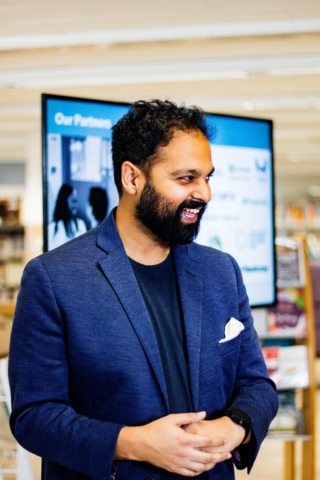
As the UK’s impact economy continues to grow, more attention is being paid to the role business can play in solving social and environmental challenges. Umesh Kumar, Head of Venture Support at Allia Impact, explains why mission-led founders need more than good ideas and ambition to succeed – and why strong local ecosystems and practical support matter more than ever.
The UK’s impact economy is growing. Government is paying more attention. Investors are paying more attention. Corporates are paying more attention. More people are asking how business can help solve social and environmental challenges. All of this matters.
But the long-term success of the impact economy will ultimately be determined by something much closer to the ground: whether mission-led founders have the support they need to build sustainable organisations.
More than a strong mission
At Allia Impact, we work with entrepreneurs building businesses around issues such as health, climate, employment, digital inclusion and community resilience. These include great businesses, such as LendoCare, Yellownest and Chef da le Maison. They are passionate, capable and deeply connected to the problems they are trying to solve.
Chef da le masion
What many other mission-led businesses are not always connected to, however, is high quality support.
One of the biggest misconceptions about entrepreneurship is that success comes down to having a great idea. In reality, the founders who make the most progress are often those who have access to the right people at the right time. Someone who can challenge an assumption. Someone who can introduce a customer. Someone who can explain pricing, governance, sales or investment readiness. Someone who believes in them before everyone else does.
The power of local ecosystems
We’ve seen this across our work in Cambridge, Peterborough, London and Nottingham.
Different places face different challenges, but the pattern is remarkably consistent. Founders rarely struggle because they lack ambition. They struggle because they are trying to build alone. That is why local support matters.
A workshop can be useful. A grant can be valuable. A networking event can create opportunities. But lasting growth usually comes from relationships rather than one-off interventions.
Take the founders we support through our business support programmes. Many arrive with a strong mission but limited commercial experience. Through mentoring, peer support, practical workshops and introductions, they gain access to the knowledge and networks that help turn an idea into a sustainable organisation.
Building the conditions for growth
We’ve seen founders secure investment, launch new services, create jobs and win customers. Not because someone handed them a solution, but because they had the right support around them at key moments in their journey.
If we want more mission-led businesses to succeed, we need to invest not only in founders but in the environments around them. We need stronger connections between entrepreneurs, corporates, universities, local authorities, investors and community organisations.
Successful businesses do not emerge in isolation. They emerge from ecosystems where people share expertise, open doors and create opportunities for one another.
The UK does not lack talented founders. We meet them every day, but what many of them need is practical support, trusted relationships and access to people who can help them move forward.
Ambition matters. But ambition alone is rarely enough.